
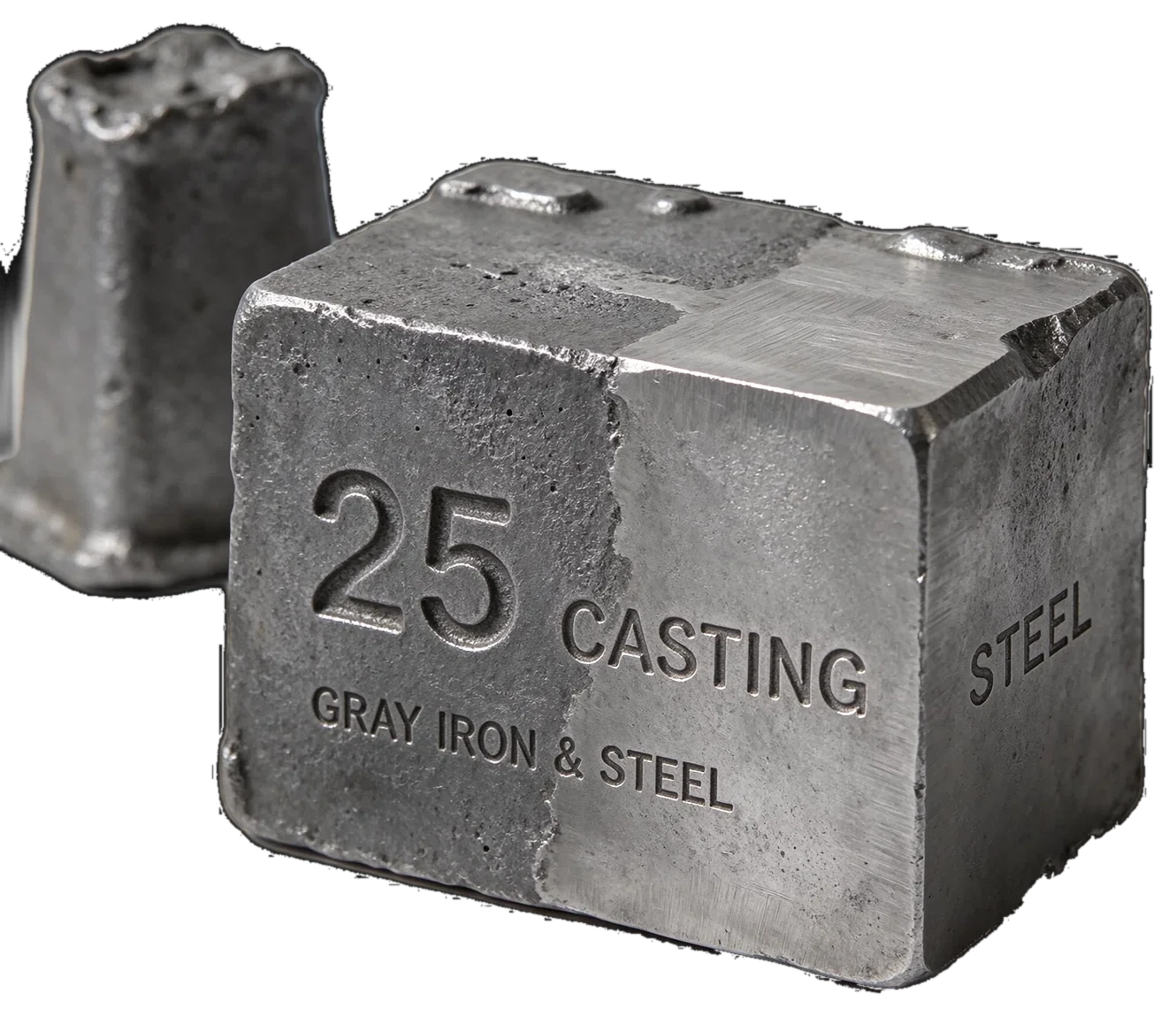
The elements that decide the grade
Carbon equivalent, not carbon alone, is the number the melting floor argues about. It combines carbon with manganese, silicon, phosphorus and the alloying elements, and it is only useful if every input is measured on the same calibration.
- Carbon and sulfur — the two elements that force a wide wavelength range. Both are checked on the same chill-cast sample as the rest of the programme.
- Silicon and manganese — the day-to-day correction elements for grey and ductile iron.
- Magnesium and cerium — treatment verification for ductile iron, where the result fades within minutes and timing matters as much as accuracy.
- Phosphorus and sulfur — specification limits that are easier to control at the furnace than to explain at the customer.
- Chromium, nickel, molybdenum, copper — alloyed and wear-resistant irons, where the base programme has to extend beyond the plain grades.
Grey, ductile, compacted graphite and malleable irons share a base but not a programme. The magnesium range that signals a good ductile treatment would be a defect in grey iron, so the grade library has to know which family is being poured.
Sample practice is half the method
White iron, chill cast, is the sample form OES needs for cast iron. A sand-cast or slow-cooled sample gives graphite flakes or nodules that disturb the spark and bias carbon and sulfur. The practical routine is a copper or iron chill mould, a fixed filling practice, and a controlled cooling time before surfacing.
- Take the sample from the stream, not from the ladle surface.
- Keep the mould temperature and filling time consistent; note them when a result looks odd.
- Surface on a lathe or dedicated grinder, avoiding overheating and oil.
- Analyse before inoculation effects fade, and record the time between sampling and measurement.
Where the result disagrees with combustion analysis on carbon or sulfur, the sample form and the standardisation are the first two things to check — not the instrument.
Configuration for iron foundries
- SDB-910 — 16-channel CCD, 120–800 nm. The wider range is the natural choice when carbon, sulfur and phosphorus have to be measured together with the alloying elements.
- SDB-810 — 16-channel CCD, 130–700 nm. Suitable when the programme is fixed around a known grade list and the shorter wavelengths needed for carbon and sulfur are covered.
Ask for an Fe-base programme written against your grade list, with the carbon equivalent elements explicitly included, and a separate programme for alloyed irons if you pour them. Combustion carbon/sulfur analysis remains the reference method for disputes; the OES is the production instrument that keeps the furnace in range between reference checks.
From furnace to certificate
A workable sequence for a ductile iron foundry looks like this: base iron check before treatment, treatment verification on a chill-cast sample, inoculation confirmation on the first cast, and a retained sample per heat. Each step answers a different question, and none of them is served by a single analysis at the end of the shift.
Recording the carbon equivalent calculation next to the measured chemistry turns the spectrometer into a control tool rather than a reporting tool. When a heat misses, the record shows whether the base iron, the treatment or the inoculation moved.
What to send for a quotation
The grade list, the iron families poured, the sample form you can produce, the number of heats per day, and whether combustion analysis is already on site. With those five answers the element programme, the platform and the sample preparation scope can be fixed before price.
Common questions
Can OES replace combustion analysis for carbon and sulfur?
For production control, OES on a proper chill-cast sample is fast and workable, and many foundries run it that way. For referee analysis, certification and disputes, combustion infrared detection remains the reference method. The two are complementary, not interchangeable.
Why does the magnesium result change between two samples?
Magnesium fades quickly after treatment, and the sample taken from the stream versus the ladle surface can differ. Fix the sampling point, chill mould and time between sampling and analysis, and the scatter usually narrows.
Do we need a different programme for alloyed irons?
Yes. Alloyed and wear-resistant irons push chromium, nickel and molybdenum into ranges that a plain grey iron programme does not cover well. Add the programme with the grade list rather than modifying one later.
Configure a system for this application
Send the alloy list, sample form and throughput